Episode Transcript
[00:00:00] Are you like most founders? Will you waste months building an mvp? Most founders follow the lean startup playbook perfectly. You'll build minimal, launch fast, feedback, iterate. There's one critical step that comes before building anything, and skipping it is why 90% of MVPs fail. If you don't know me, I'm Victor. And after guiding over 300 founders, I've seen the same pattern over and over again. In this video, I'll show exactly why the MVP approach is broken, the costly mistakes it forces you to make, and what successful founders do instead. If you're about to build an mvp, this could completely change your approach.
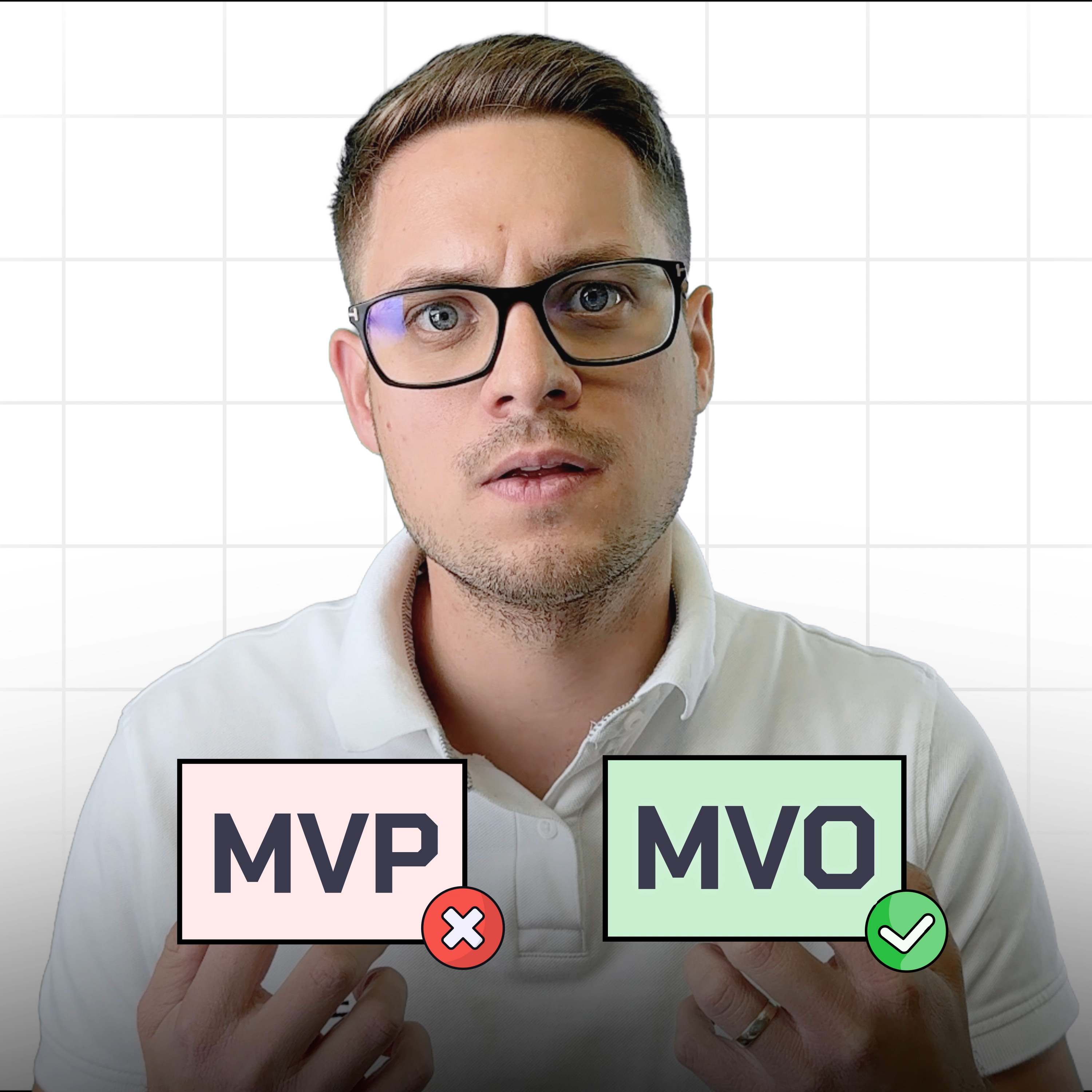
[00:00:44] Now you might be thinking, if building an MVP is not worth it, why do people still build those? Well, because the idea itself sounds smart, right? At first, you build a classic basic version of your product. You got to get it into people's hands, you know, mostly real customers, as fast as possible. You get their feedback, you iterate and you find product market fit. It's good, right? That's a dream that's being sold to you. But then you realize that that really is the old way. Ironically, this used to work when it was harder to make an MVP and there weren't a lot of choices for the customer because of that. And usually it was technical founders, developer founders whose own time moonlighting didn't cost them much, who built those. I've been in those communities such as Microconf and SaaS Academy for over a decade and I have follow these people's success and worked with many of them. But that stopped working. Now the market has changed. There are a lot more people doing this way, more choices. It's just one of the reasons. But that doesn't mean that there is not a chance. There are a lot of chances in SaaS. You just need to understand how to approach them. And so to understand why MVPs aren't worth it right away, you need to know what are the four main reasons for that. So first, most MVPs first fail, at least the first, because most founders think, oh, I will launch my MVP and just quickly reach product market fit. People underestimate that. But after working with hundreds of founders, the reality I found is that product market fit takes a lot of iterations. And iteration cost on full blown software, even if it's just an mvp, is high. And at this point revenue from subscriptions just usually doesn't cover the expenses. So some people call this a slow, long SaaS ramp of death. So that is the first reason why most MVPs fail or take Much longer to succeed than people expect. Second, building software is incredibly expensive. Hiring good developers costs a fortune. So if you're not a developer yourself, you can easily spend many tens of thousands of dollars just to get a half baked version out the door. And third, you're doing all of this without any real proof that customers want what you're building. You're basically taking a massive expensive guess when there is something far simpler that you can do. But now you might ask yourself, but Victor, what about Zoom? What about Slack? They just built something, released it, and they succeeded right away. Yeah. And the reason here is as follows. They had deep insider knowledge in previous experimentation. They could rely on people who are already in an industry or deeply understand the pain they've experienced firsthand. This was the case for Zoom and Slack, by the way, and I'll go deeper into that in a second. But the people who build MVPs without prior knowledge have a very long and hard road ahead of them. Just look in Airbnb. The founders were designers in theory, software product experts, right? But they weren't hospitality insiders. So their idea of offering mattresses to strangers was so radical that for four years they struggled, pivoted, and nearly went broke multiple times before their persistence finally paid off. Or Atlassian, the company behind Jira. The founders weren't project management experts. They were just looking for gaps in the market. Took them years of painful iterations before they found their groove, eventually leading to an IPO more than a decade after they started. So what should you do instead of building an mvp? Let me show you what to do with the example of Slack. Slack didn't start as a billion dollar idea at all. It started as an internal prototype. A team of developers were building. A video game was called Glitch and they were frustrated with email. So they built their own internal chat tool to communicate better across time zones. That tool was the first version of Slack, but then the game failed. The company was about to just shut down. But they realized something. Even though their main product failed, their internal prototype, this little chat tool was incredibly valuable and it was already proven to work. So they went out to their friends at other tech companies, showed them their internal tool and made them an offer. Hey, we built this for ourselves and this changed how we work. Would you use it? The response was a yes. This is called a minimum viable offer or an mvo. It's about testing a promise before you build the full product. Now, traditionally, an MVO could just be a landing page or a video. But in my experience working with founders There's a method that's even better. Making a minimum viable offer with a prototype. Thanks to all those new AI tools. Building a prototype that looks and feels real is just no longer a massive hurdle even for non technical founders. This combination is what truly de risks the entire process. And this approach is ridiculously powerful because first of all, it is way cheaper and less time consuming than an mvp. While you might still hire a designer or a developer to help with a prototype, you don't have to do that yourself or learn all of the tools. You're avoiding the massive bank draining cost of writing custom code, spinning up servers and months of complex development. Second, you're getting the right kind of feedback early on. You're getting feedback on a simple prototype that showcases your core idea. This helps you confirm that people actually want your solution before you waste time and money building out features nobody asked for. Feedback on a product people can get their hands on is much deeper than feedback on a landing page or even a demo video. Thirdly, it's really perfect for non technical founders. You can use no code tools or even run a manual service to create your prototype, allowing you to test your business model before investing heavily in a tech team. Fourth, because you haven't built much, you can change direction very easily based on what works right. If the offer is bad, you can adjust the offer reposition, try a different market before building out features very hard. Once you already have a big mvp. I know minimal and big, but still that's what it ends up being compared to a prototype. And finally, it gives you more clarity on what to do. An MVP asks would you use this product day to day? But an MVO with a prototype asks, do you even want this product right? So this changes the focus from a product to a promise transformation. Now this MVO with a prototype approach is powerful, but here's the reality. Most non technical founders still struggle with execution. Sure, I mean it's a new thing for everybody. They know they should validate first, but they don't know how to craft the right offer, find reliable developers, or manage the technical process without getting burned big one. That's why I created SaaS mastery in which I help non technical founders go from raw idea to launched SaaS prototype in two to six months, all without learning to code or giving away equity. You get the complete roadmap product concept, access to our vetted developer network, and if needed, a fraction CTO to guide you so you can build the right prototype and final product fast. If you're ready to stop wasting your time and money. Just click the first link in the description. Talk to me. I'd be very happy to work with you. But before I tell you how your process should exactly look like, you have to make sure to not fall into the trap of thinking that if a software is valuable for you and increases your productivity, it will do the same for everyone.
[00:08:13] Sometimes it depends on how other businesses are structured, how they grow, what resources they have and which they are lacking. And whether their leadership has understanding and vision for technology.
[00:08:24] Sometimes switching costs and change management can make selling your software very hard. I've seen it all and that's where a prototype is really valuable. Because even if you know that something works for you, you can test that it also works for others before you spend the big bucks. So what should your roadmap look like now? How do you go from idea to paying customers without a lot of pain? Your first step is to forget about the MVP and build that prototype. This is where you turn your idea into something you can either use internally or you can show it to others so that it works or just can be built on lovable or even a manual service where you deliver the results yourself behind the scenes. Which is really our main goal, to show, not just tell. Because this will allow the user to test faster, which means faster feedback and faster iteration. And also this is why or how I started my previous company. Before we built software platform, we manually connected developers and teams to make sure this is what people wanted and how people wanted it. Now the second step is building the mvo. And this is where your package your solution into a clear offer and test whether people are willing to commit. If they are, you've validated demand and maybe even collected upfront revenue. Great. And now the last step is finally building your mvp. Once you have a waiting list of paying customers, you've got the ultimate green light. You have a validated concept, you have your first users and you have the revenue to help fund the development. Now and only now should you think about building the software. So. So the final roadmap looks like this number one prototype. Then the MVO and presale and then the mvp. So there you have it. The broken MVP model and the new playbook to replace it. We went from gambling your time and money on a product to building a predictable business on a validated offer. The MBO framework works, but execution is where most non technical founders get stuck. So if you want help, just click the first link and we will talk. Thank you so much for watching. Thanks.